
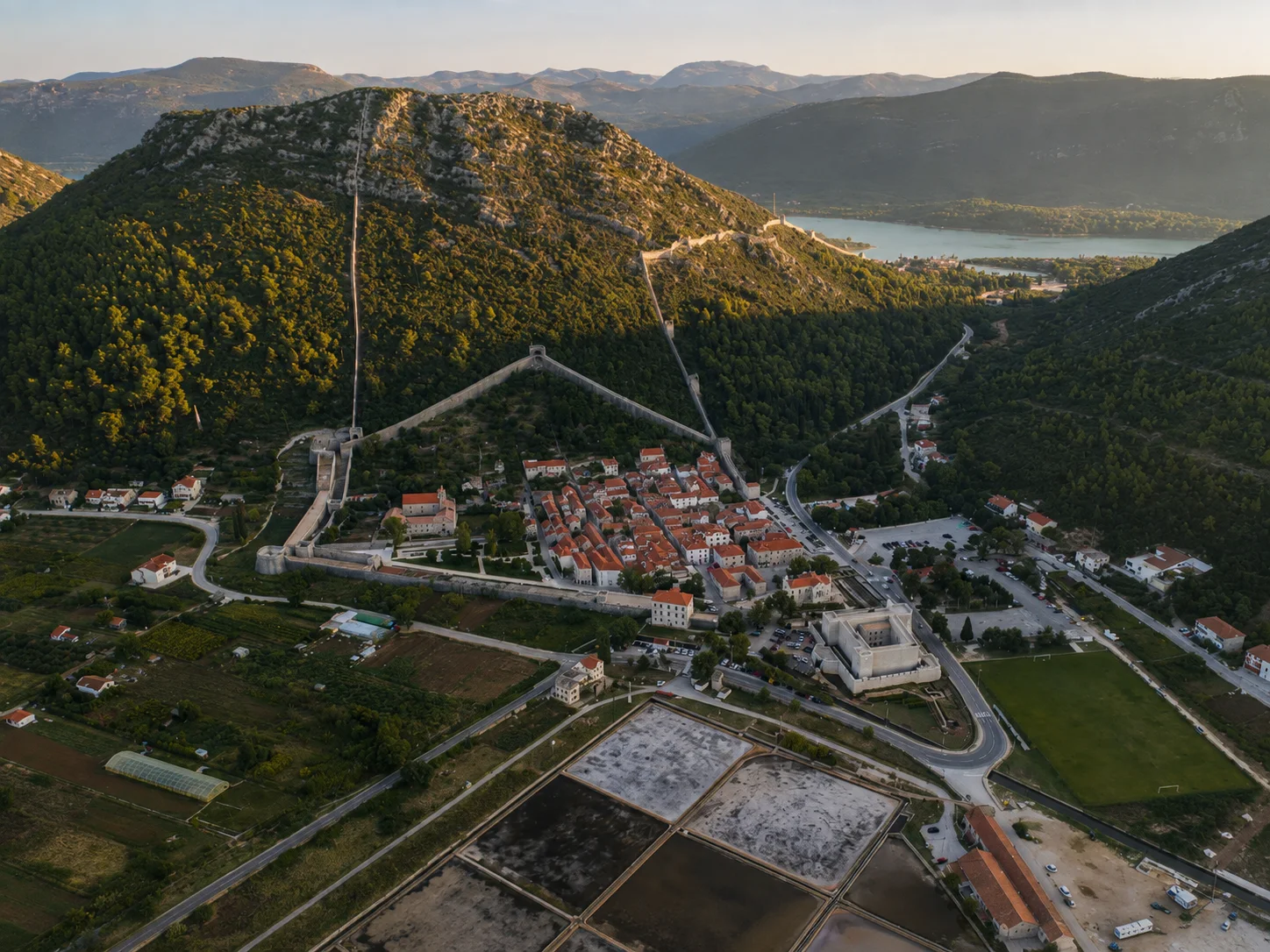
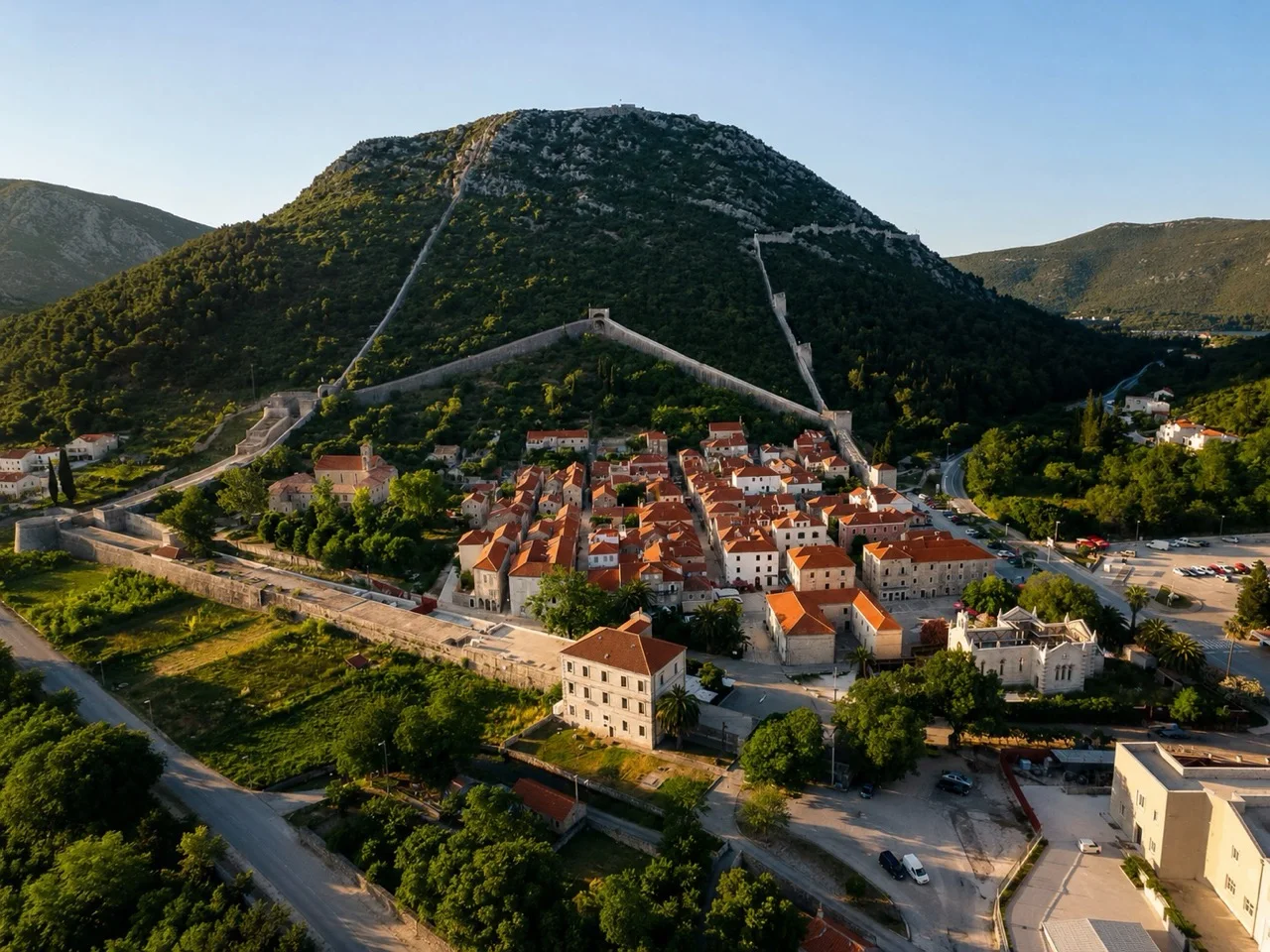
There is a particular kind of Croatian morning in Ston. The stone is already warm, the air carries a trace of the sea, and the mountains gather around the town rather than simply standing behind it. Before the heat settles in, the medieval walls climb away from the rooftops in a pale line across the narrow neck of the Pelješac peninsula. Below them are salt pans, fields, cypress trees and the sheltered waters of Mali Ston Bay.
The Ston Walls walk is often described as a nearby alternative to Dubrovnik’s famous city walls. The comparison is useful, up to a point. Dubrovnik offers a spectacular circuit above a dense historic city; Ston offers a walk through the infrastructure of a medieval territory. Fortifications, salt production, food and landscape still belong to the same story.
That is why Ston deserves more than a quick photograph from the road. Come for the view, but allow time to understand what it shows.
What the Ston Walls walk is really about
Ston and nearby Mali Ston were developed under the Republic of Dubrovnik after the territory came under Ragusan control in the fourteenth century. The settlements were planned, fortified and connected by walls across the peninsula’s narrowest point. The defensive system protected the towns, the route inland and, crucially, the valuable salt-producing area.
The wider system once extended for roughly seven kilometres. Today’s visit centres on the surviving and restored sections, including the town walls and the steep route commonly known as the Great Wall of Ston. Expect steps, uneven stone, exposed sections and a climb that feels more demanding than its length suggests.
Start in Ston, not at the viewpoint
Begin in Ston itself. The compact street plan makes orientation easy, and the town deserves a little time before the climb. Notice the regular blocks, stone houses, churches and the way the settlement sits against the fortifications.
Ston is not a museum set apart from daily life. Cars pass through, restaurants open onto small squares and local businesses occupy buildings whose proportions belong to an older urban world. That everyday scale is part of its appeal.
The wall entrance is reached from the town, and the route rises quickly. This is not a smooth promenade. In summer, the stairs and open sections can be hard work, particularly in the middle of the day.
Take the climb slowly. Stop often, look back and let the landscape come into focus in layers. The walk is more enjoyable when treated as an outing in its own right, rather than a race to the highest point.
The climb: stone, wind and changing views
As the route gains height, Ston contracts into terracotta roofs and pale walls. The saltworks spread below in geometric pools, their appearance changing with the season, the sun and the stage of evaporation. Beyond them, Stonsko Polje opens into a cultivated plain framed by rugged hills.
The most satisfying feature is the change of scale. One moment the wall is an intimate construction of fitted stone, narrow steps and parapets. The next it becomes a line drawn across the landscape. Towers and bastions appear as practical responses to the terrain rather than isolated monuments.
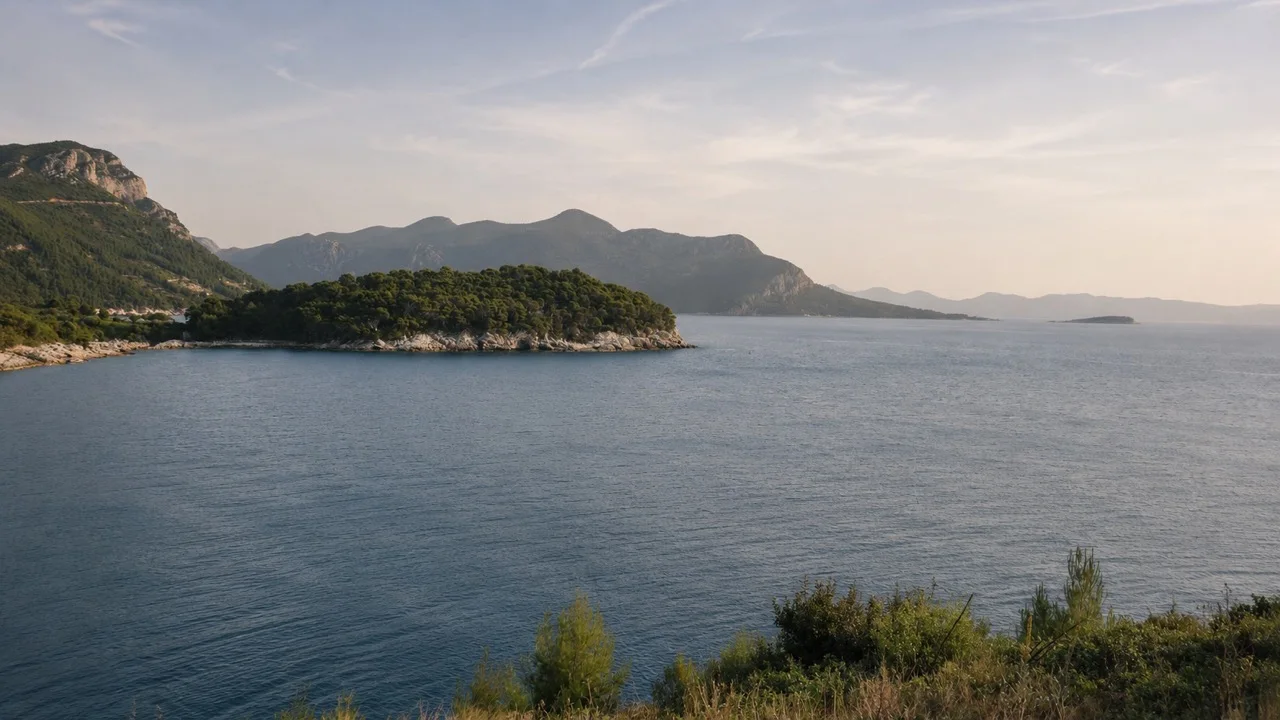
On clear days, views extend across the bay and into the wider Pelješac landscape. Much of the route is exposed, however, and the stone stores heat. A morning start is the sensible choice in warmer months. Bring water, a hat, sunscreen and shoes with reliable grip.
How to plan the walk
Give the walls at least part of a morning rather than treating them as a quick viewpoint stop. The exact duration depends on which sections are open, how far you walk and how often you pause. Add the town, saltworks, lunch and Mali Ston, and the visit can comfortably occupy most of a day.
- Start early in summer, when the sun is less intense.
- Wear walking shoes with a firm sole; polished or irregular stone can be slippery.
- Carry water. Services are concentrated in the town rather than along the walls.
- Do not assume the route is suitable for strollers, wheelchairs or anyone uncomfortable with steep stairs and exposed edges.
- Check current opening arrangements and ticket information before setting out, particularly outside the main season.
- Allow time for stops. The best views appear gradually rather than at one clearly defined lookout.
The walls are a historic structure, not a modern hiking trail. Conditions may change after bad weather, maintenance or conservation work. Follow posted instructions, stay on the permitted route and do not climb beyond barriers for photographs.
The salt pans explain Ston’s importance
After the walls, descend towards Ston’s saltworks. The change is one of the most rewarding parts of the day: defensive architecture gives way to a low, horizontal landscape of channels, evaporation basins, embankments and crystallisation fields.
The salt pans are not simply a scenic backdrop. They are the economic reason this small settlement mattered for so long.
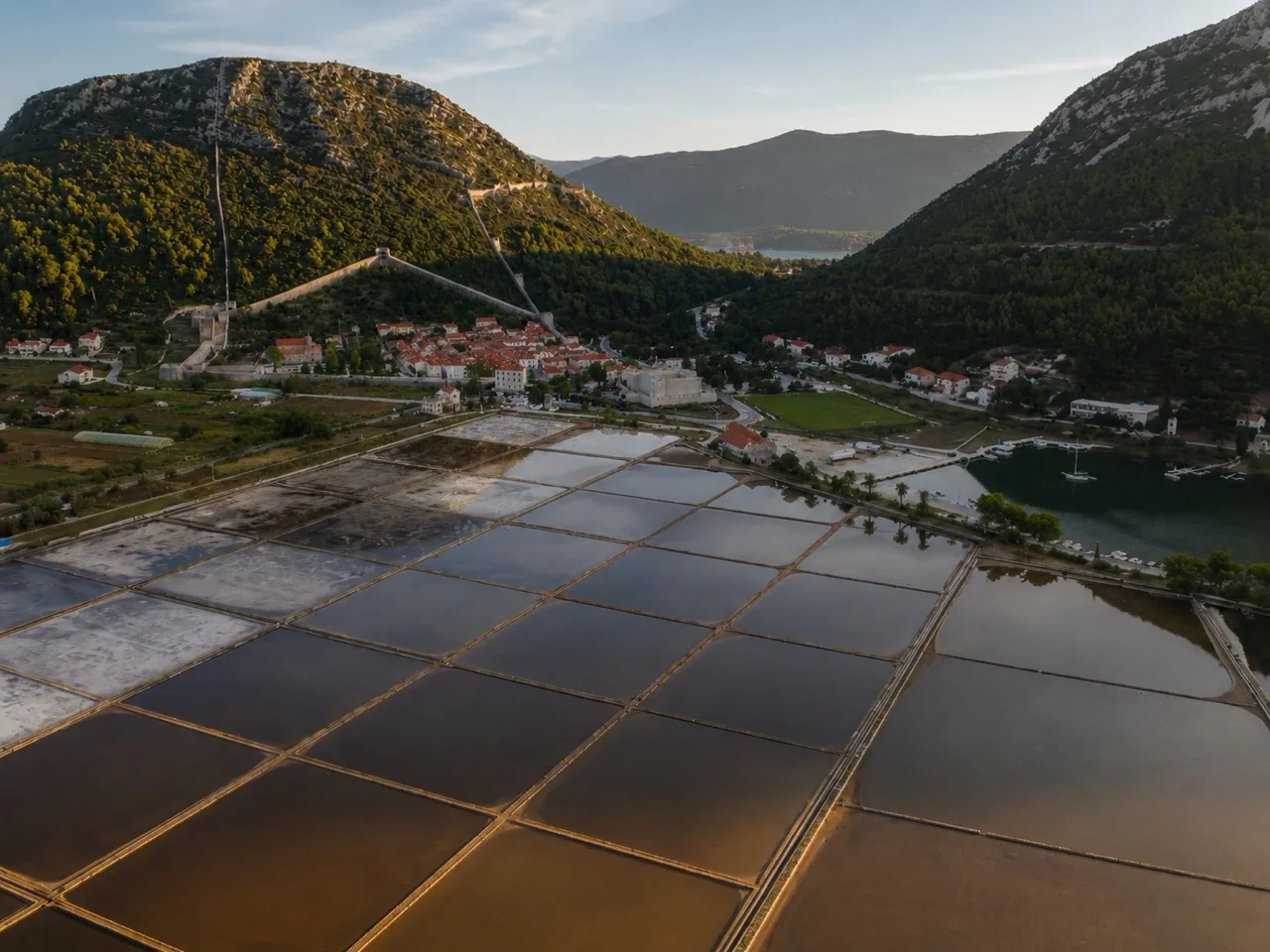
Salt is produced through natural evaporation, using seawater, sun, wind and human labour. The interest lies in the continuity: this is not only a vanished medieval craft presented as heritage, but a working landscape that remains productive.
The appearance of the pans varies through the year. Harvesting season can make the process especially vivid, although a visit at another time still reveals the scale and ingenuity of the installation. Guided visits, screenings and access arrangements may vary, so confirm details locally.
Look closely at the sequence of pools. Water moves through organised stages as evaporation increases the concentration of minerals. The landscape resembles an agricultural field, although its crop comes from the sea.
A landscape shaped by work
Ston is most compelling when scenery is understood as something made and maintained. The hills, fields, bay and saltworks depend on natural conditions, but generations of people have measured, divided, harvested, defended and adapted them.
From the wall, the salt pans look almost abstract. At ground level, their practical character returns: dikes need maintenance, water levels need managing and harvests depend on weather. The white surfaces are the visible end of a process that requires patience and timing.
Oysters in Mali Ston Bay
The other great Ston tradition comes from the water. Mali Ston Bay is known for cultivating the European flat oyster, Ostrea edulis. The local oyster, commonly called kamenica, has a long regional tradition and is associated with protected geographical status within the European Union’s quality system.

Mali Ston is the natural second part of the visit. It is smaller and more intimate than Ston, with a waterfront facing the bay and oyster farms beyond. Depending on the season and operator, visitors may be able to arrange a tasting or boat visit. Check ahead, as availability varies.
Oyster tasting is closely tied to place: sheltered water, freshwater influence, cultivation practices, low boats, ropes and limestone slopes all form part of the experience. If oysters are on the menu, start simply and taste one without embellishment before adding lemon. Local white wines such as Pošip are a natural pairing, while sparkling wine is also commonly served.
As with all raw shellfish, follow local food-safety advice and choose established operators.
From Ston to Mali Ston
The two settlements are close enough to combine in one itinerary, but the road-level connection is not simply an extension of the wall-top route. The historic walls cross the hills; the modern road is the more practical option for those avoiding the full ascent or travelling with limited mobility.
If you walk between the towns at ground level, confirm the safest current route locally and take the road environment seriously. The fortified connection is more meaningful for walkers, but it includes steep and uneven sections. There is no need to complete every metre if conditions make the day uncomfortable or unsafe.
A slower alternative to Dubrovnik
Ston is not a substitute for Dubrovnik. Dubrovnik’s walls rise above a dense historic city, a working port and a more concentrated urban drama. Ston is quieter and more dispersed. Its appeal builds through several connected experiences: a fortified town, a long climb, a salt harvest, a plate of oysters and a view across the bay.
This is the better choice for travellers who want history to remain connected to food, landscape and local work. If you have only a few hours, prioritise the walls and the saltworks. If you have a full day, add Mali Ston and lunch. An overnight stay makes sense for anyone continuing across Pelješac or wanting to explore without rushing.
Food, wine and what to order
Ston’s food culture follows its geography. Alongside oysters, look for mussels and other shellfish from Mali Ston Bay, grilled Adriatic fish and dishes made with produce from the Pelješac peninsula. The region is also associated with robust red wines, particularly Plavac Mali, grown on steep coastal vineyards elsewhere on the peninsula.
Ston cake is the local speciality to seek. It is a dense pastry traditionally made with pasta-like dough, nuts, spices and a rich filling. Recipes and presentations vary, and not every restaurant serves it daily, so ask rather than assume.

Reserve ahead during summer and around local festivals. Seafood restaurants can fill quickly, while smaller family-run places may keep limited hours. In this landscape, freshness and provenance matter more than an elaborate menu.
When to go
Spring and early autumn offer the most comfortable balance of manageable temperatures, softer light and a less pressured pace. Summer brings the most reliable visitor services and liveliest restaurant scene, but the exposed wall can be intensely hot at midday. If the walk is the priority, plan around the sun rather than lunch.
The saltworks are most atmospheric when the pans are active, while oyster experiences follow the farming calendar and local operators. Winter can be peaceful, but opening hours, transport, tastings and guided visits may be limited. Check current conditions before travelling.
Getting there and making the most of Pelješac
Ston is commonly visited between Dubrovnik and the Pelješac peninsula, and works well as either a day trip or an overnight stop. Driving offers the greatest flexibility for combining Ston, Mali Ston, vineyards, beaches and villages farther west. Bus connections may be available, but schedules can be seasonal and should be checked for the specific date.
The opening of the Pelješac Bridge has made some journeys in southern Dalmatia more straightforward, although travel times still depend on traffic, road conditions and the starting point. The more useful planning question is whether to give the area enough time, rather than how quickly to pass through it.
An overnight stay changes the pace. Early morning brings the walls before the strongest heat, while evening allows the town and bay to settle after day visitors leave. It also makes it easier to explore the peninsula’s vineyards and coastal roads without turning the day into a series of hurried stops.
A practical itinerary
- Morning: arrive in Ston, orient yourself in the historic centre and begin the wall walk before the heat builds.
- Late morning: descend to the saltworks and check current tour and opening arrangements.
- Lunch: choose Ston for historic-town atmosphere or Mali Ston for a bay-side setting.
- Afternoon: arrange an oyster tasting, visit a local producer or explore a small section of Pelješac’s wine country.
- Evening: stay for dinner or remain overnight for a quieter view of the fortifications.
Is the Ston Walls walk worth your time?
Yes, if you want a compact visit where history, food and landscape are closely connected. The walls alone are worth the climb, but the full value of Ston appears when you look down: the salt pans, fields, bay and rooftops explain why this narrow part of the Adriatic was defended and valued.
Give it a morning at minimum. Give it a full day if you want the saltworks, Mali Ston and a proper meal. An overnight stay is the most relaxed option for travellers continuing across Pelješac or choosing a quieter base near Dubrovnik.