Some mountain walks are built around the climb. The Rigi Panorama Trail offers a gentler way to spend time in the Alps: a high-level route above Lake Lucerne that follows the eastern flank of Mount Rigi between Rigi Kaltbad and Rigi Scheidegg. The walking is comparatively gentle, the scenery expansive and the logistics unusually straightforward. You can arrive by cogwheel railway or cable car, spend several hours on the mountain without committing to a major summit ascent, and return by mountain transport at either end.
That balance gives the trail its particular character. The railway is part of what makes this outing work, allowing you to begin within the landscape with time and energy left for the walk itself. Along the route, the views shift between the folds of the mountains, the lakes below and the old railway infrastructure threaded through the hillsides.
A trail designed around changing views
The Rigi Panorama Trail is generally described as a route of about 7 kilometres, or slightly more depending on the precise start and finish points used. The usual direction runs from Rigi Kaltbad to Rigi Scheidegg, also known as the Rigi Scheidegg–Burggeist area. Walking time is often given as roughly two hours, although that estimate assumes a steady hiking pace and few long pauses. For a mindful day, allowing three to four hours is more generous and more realistic.
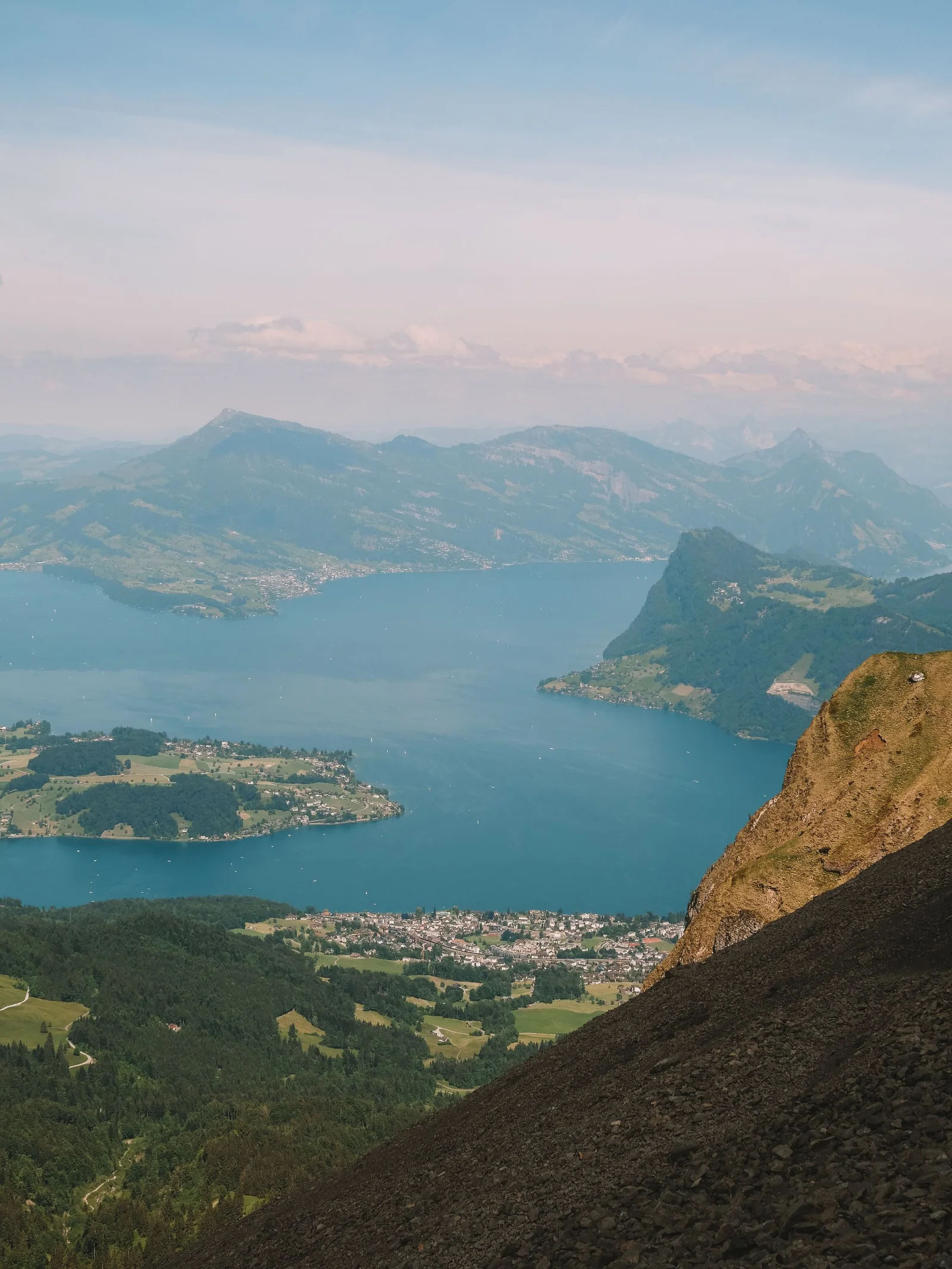
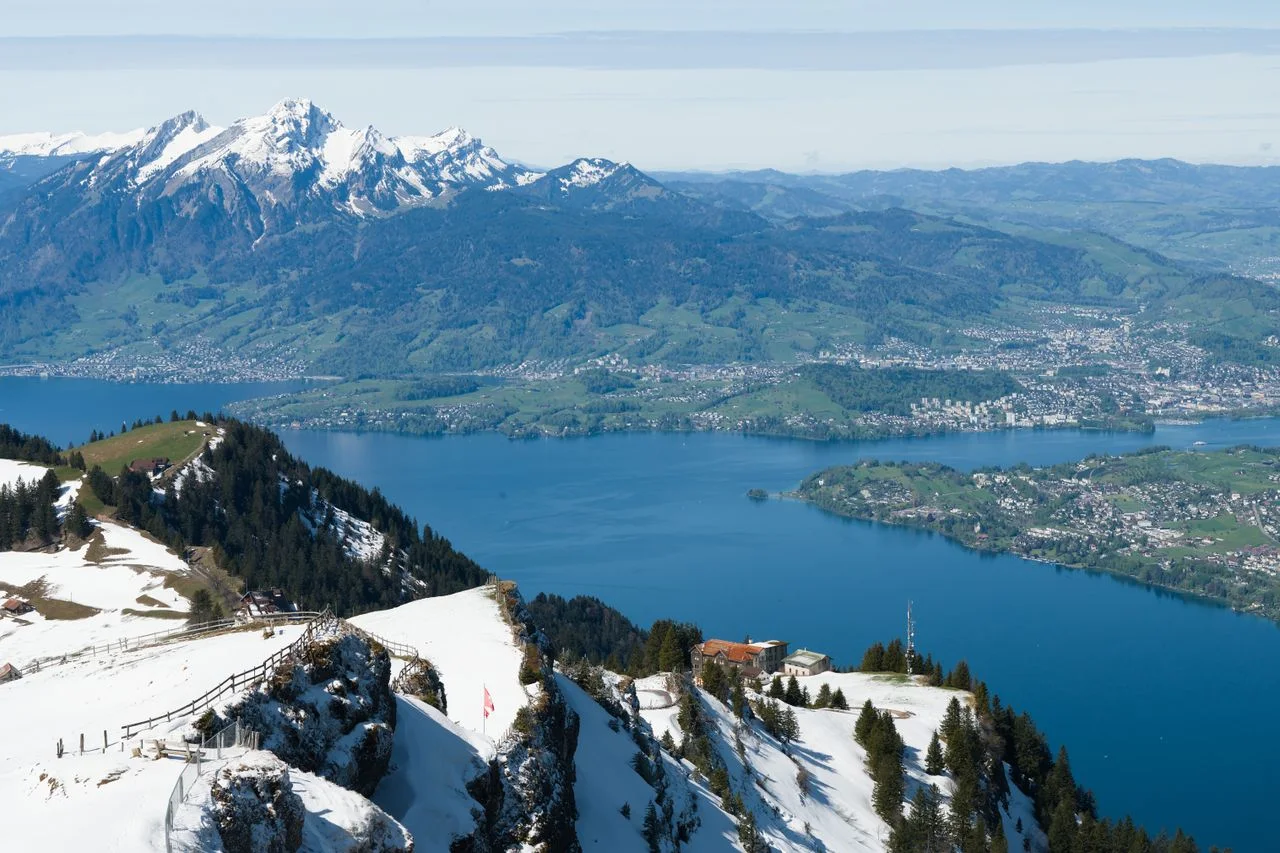
The trail’s appeal is not one single viewpoint. It is the sequence. Lake Lucerne appears and recedes as the path curves around the mountain. The perspective shifts towards the surrounding foothills, then opens towards larger Alpine ranges. Meadows give way to wooded sections; historic engineering features interrupt the pastoral scenery; a bend reveals a new arrangement of ridge, water and sky.
On a clear day, the visual field can extend far beyond the immediate lake country. On a hazier day, the experience becomes more intimate: wet grass, stone walls, cowbells, low cloud and the sudden brightness of a distant slope. The trail rewards returning the gaze to the near ground as often as lifting it towards the horizon.
Why the pace matters
The Rigi Panorama Trail is easy to rush because it is accessible and well known. There is a tendency to treat it as a scenic transfer between two transport stations: disembark, take photographs, walk briskly, board the next connection. That approach is efficient, but it misses the quality that makes the route memorable.
A better rhythm is to walk in small intervals. Move for twenty or thirty minutes, then stop—not necessarily at a formal viewpoint, but wherever the landscape changes. Notice what has entered the view since the last pause. Is the lake wider now? Has the path moved from open pasture into shelter? Does the mountain ahead look nearer, or has the horizon become more distant?
This kind of pacing also makes the route welcoming to mixed-ability groups. The strongest walker does not need to set the tempo, and a slower companion does not have to feel that they are holding everyone back. The walk becomes less about reaching the destination quickly and more about sharing the same changing field of attention.
The route, section by section
Most walkers begin at Rigi Kaltbad, reached by the cogwheel railway from Vitznau or by aerial cable car from Weggis. Rigi Kaltbad is a developed mountain station with accommodation, dining and other facilities, so it works well as a calm starting point. Before setting off, this is the place to check the weather, fill water bottles and confirm the return connection.
From Rigi Kaltbad, the trail proceeds along the mountain towards Rigi First and the wider ridge leading to Rigi Scheidegg. The opening kilometres are particularly suited to an unhurried start. The path moves through open terrain with broad views, while the slope remains modest compared with a conventional summit hike.
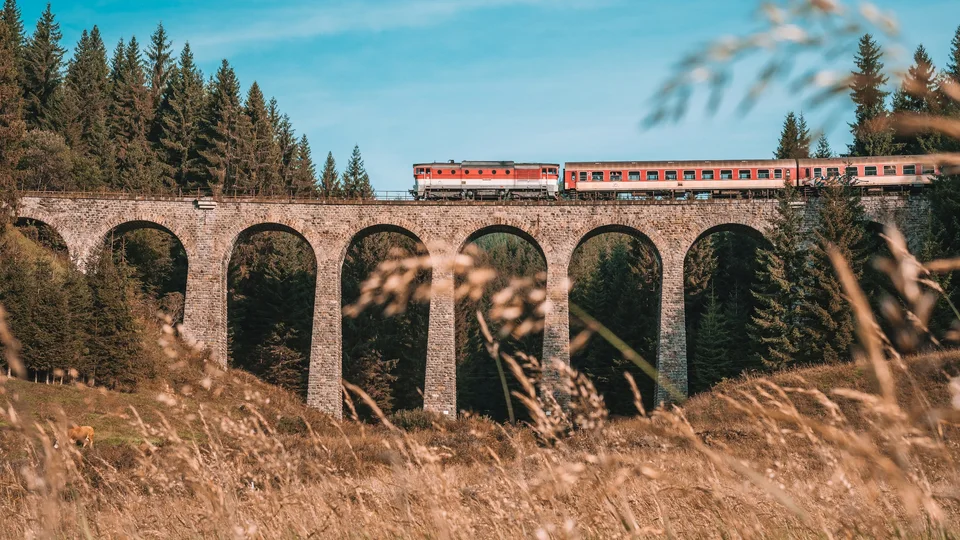
Near Unterstetten, the route passes through a landscape where the traces of the former Rigi-Scheidegg railway are especially meaningful. Historic structures, including a tunnel and viaduct, recall an earlier era of mountain travel. They are not museum pieces placed apart from the landscape; they are part of the route’s story, evidence of how people have long sought ways to move through the Alps without turning every journey into an act of endurance.
The section around Unterstetten is also a natural place to pause. A barbecue area is located beside the panoramic trail, making it useful for families or anyone carrying a simple picnic. Even without stopping for a meal, the area encourages a slower transition between the open viewpoints and the more enclosed sections of the walk.
Continuing towards Rigi Scheidegg, the route maintains its high-level character. The views become more varied rather than simply grander. One moment the eye follows the lake towards the settlements below; the next it settles on the texture of a nearby pasture or the profile of a wooded ridge. The final approach may feel more uneven than the broadest sections of the trail, so travellers relying on particularly smooth access should check current conditions before departure.
Mountain transport as part of the experience
Mount Rigi is served by a network of cogwheel trains, aerial cable cars and other mountain connections. The most atmospheric arrival is arguably by cogwheel railway from Vitznau, whose route climbs from the lakeside into the mountain landscape. The cable car from Weggis offers a different transition, lifting passengers directly from the Lake Lucerne region to Rigi Kaltbad.
For the trail itself, transport is not merely a practical prelude. It changes the scale of the outing. A visitor can experience the drama of the ascent without spending hours climbing, then use their physical capacity for the horizontal journey along the ridge. This is particularly valuable for families, older walkers, people recovering from injury, and anyone who wants an Alpine day without a demanding vertical profile.
At the far end, the cable car from Rigi Scheidegg or Burggeist can provide a descent towards the valley, depending on the chosen endpoint and current operating arrangements. Other itineraries combine the Panorama Trail with a descent towards Seebodenalp, Küssnacht or the Lake Lucerne shore. These combinations can be elegant, but they require careful timetable planning because several transport operators and seasonal services may be involved.
- For a straightforward outing, travel up to Rigi Kaltbad, walk to Rigi Scheidegg and descend by the available mountain connection.
- For a lake-and-mountain day, combine the walk with a boat or bus connection around Lake Lucerne, subject to the current seasonal timetable.
- If using more than one railway, cable car, bus or boat, allow a generous margin between connections.
- Check the final descent before starting the walk; a beautiful route is less relaxing when the last connection becomes a race.
Accessibility and the idea of an open mountain
The Rigi Panorama Trail is promoted by the local mountain railway organisation as an accessible, largely barrier-free route, and parts of it are described as suitable for strollers. That is significant in a region where many celebrated walks involve steep ascents, narrow paths or rough mountain terrain. Here, the railway and cable-car network allows more people to experience an elevated Alpine landscape without needing to complete a strenuous climb.
Accessibility, however, is never a single category. Surface conditions, recent rain, construction work, snow, ice and the exact design of a person’s mobility aid can all affect the experience. The route may be gentle while still containing sections that feel challenging for a wheelchair user, stroller user or walker who needs a consistently smooth surface. Station access, boarding arrangements and the availability of assistance should also be confirmed directly.
The most considerate approach is to treat the published accessibility information as a starting point rather than a guarantee. Contact the operator before travelling if you have specific requirements, and ask about the current condition of the entire route—not only the transport stations. A companion should also be prepared for the possibility of turning back or shortening the walk.
When to go
The Panorama Trail is most straightforward in the warmer months, when the path is generally free of snow and the mountain transport network is operating on its main seasonal schedules. Summer brings lush meadows, long daylight and the fullest range of services, but it can also bring more visitors and rapidly changing weather.
Early autumn can be especially rewarding. The light often softens, the meadows begin to lose their summer intensity and the lower valleys may take on warmer colours. Transport timetables typically change across the season, so a late-season walk should be planned with the same care as a summer outing.
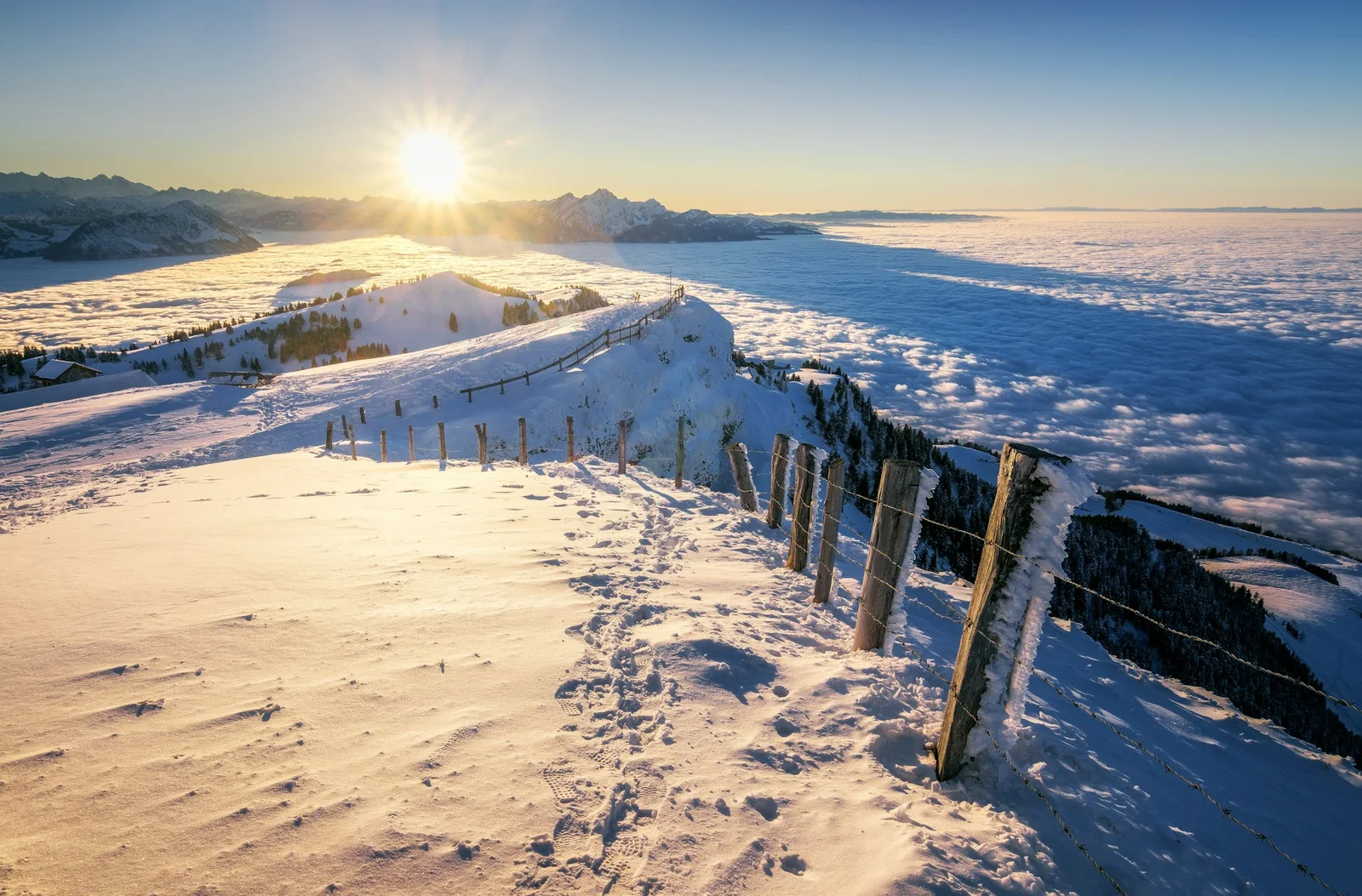
Winter is a different proposition. The route may be available as a winter walk when conditions allow, but snow and ice alter both the walking surface and the character of the trail. The operator has described the winter Panorama Trail as a route of about 7 kilometres between Rigi Kaltbad and Rigi Scheidegg or Burggeist. Always check current trail status, snow conditions and operating information before setting out.
Weather, clothing and what to carry
At mountain height, weather can change faster than it appears from the lakeside. A warm morning in Lucerne does not guarantee a warm afternoon on Rigi’s ridge. Carry a light waterproof layer, an insulating layer, sun protection and footwear with a secure sole. Even on an easy route, a mountain path deserves mountain-minded preparation.
Water and food are worth carrying, though there may be restaurants or refreshment options at the main stations and along the route. Do not rely on every facility being open outside the principal season. A small picnic also suits the trail better than a tightly scheduled restaurant stop: it gives you permission to sit when the view is right.
- A waterproof jacket and warm layer
- Comfortable walking shoes with good grip
- Water, snacks and a small picnic if desired
- Sun protection, including sunglasses and hat
- A charged phone and offline transport information
- Walking poles if they help with balance or confidence
- A small bag for rubbish, including food scraps
A quieter way to read the landscape
The trail passes through a working mountain environment, not an empty backdrop. Pastures, livestock, forestry and transport infrastructure all belong to the Rigi landscape. Close gates behind you, keep dogs under control where required, and give animals space. Stay on the marked route, particularly where ground may be fragile or where the path crosses areas used by farmers.
The old railway remains one of the walk’s most evocative details. It invites a different understanding of accessibility: the mountain has never been untouched by human movement. The historic railway made the upper slopes reachable for visitors generations ago; today’s trains and cable cars continue that relationship in a more extensive network. The walk exists within that history rather than in opposition to it.
Planning a half-day or a full day
A half-day version can focus on the trail itself: ascend to Rigi Kaltbad, walk to Rigi Scheidegg, pause for lunch and descend. This is enough for a satisfying outing, especially if the purpose is to walk attentively rather than collect additional attractions.
A full day allows more spaciousness. You might begin with a lakeside boat or train journey, take the cogwheel railway into the mountain, spend time at Rigi Kaltbad before walking, and then descend by a different route. The summit of Rigi Kulm can be added as a separate excursion, although doing so changes the day from a gentle traverse into a longer and more transport-dependent itinerary.
There is no need to make the route more ambitious simply because the mountain network makes that possible. The strength of the Rigi Panorama Trail lies in its restraint. It offers altitude without demanding conquest, distance without isolation and scenery without requiring a packed programme.
Practical details before departure
Mount Rigi is served by several transport routes, including cogwheel trains from Vitznau and Arth-Goldau and cable cars from Weggis and Kräbel. Which route is best depends on where you are staying and whether you want to return by the same side of the mountain. From Lucerne, connections can be arranged using the regional rail, boat and bus network, but exact journey times and operating patterns vary by date.
Mountain railway tickets, passes and transport inclusions can change. The Rigi operator publishes current fares, timetables and operating notices, including planned maintenance closures. Check these details shortly before travel, especially if visiting in spring, late autumn or winter. Some services run less frequently, stop on request or operate only in particular seasons.
- Choose your starting station according to the direction from which you are arriving.
- Decide in advance whether you will finish at Rigi Scheidegg, Burggeist or another nearby connection.
- Check the weather at mountain level rather than relying only on the forecast for Lucerne.
- Confirm the last descent and any transfer required at the valley station.
- Allow extra time if travelling with a stroller, mobility aid, children or a large group.
- Recheck operating notices on the day, as mountain conditions can affect services.
The pleasure of not needing to prove anything
The best reason to walk the Rigi Panorama Trail is not that it is the easiest route above Lake Lucerne, nor that it offers an impressive list of transport connections. It is that the trail creates room for a more generous idea of mountain travel. The train carries you upwards, but the path asks you to slow down. The views are wide, yet the experience can remain intimate.
Walk it as a traverse rather than a task. Let the first stretch be an adjustment from station time to mountain time. Pause when the landscape changes. Notice the evidence of older journeys in the tunnel and viaduct. Leave space for companions who walk differently. By the time the route reaches Rigi Scheidegg, the reward is not only the panorama but the settled attention with which you have arrived.
Above Lake Lucerne, the Rigi Panorama Trail offers something increasingly rare in popular mountain destinations: an Alpine walk that does not insist on difficulty as its measure of value. Its quiet achievement is to make the high country more open, then give you enough time to look around.