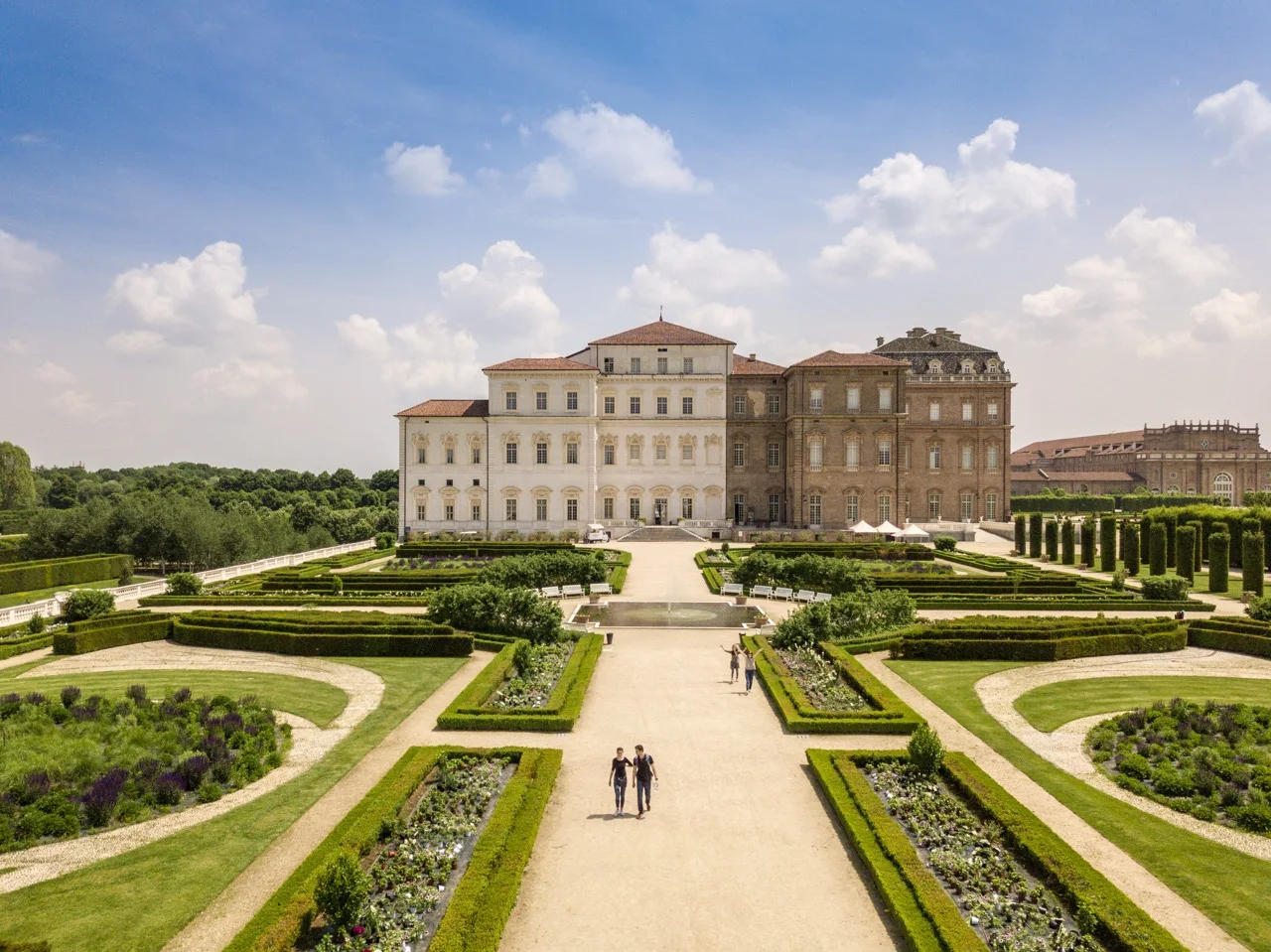
Turin has no shortage of palaces, galleries and royal residences, but the gardens of Venaria Reale offer a different kind of escape. Around ten kilometres from the city centre, the former Savoy estate opens into a sequence of formal parterres, long tree-lined avenues, water features, orchards and contemporary sculptures. The setting is grand without feeling sealed off from the landscape. You can come for the Baroque architecture, stay for the slower rhythm of the gardens, and leave with a clearer sense of how the Savoy court used nature as part of its theatre of power.
A royal estate built for hunting and display
Venaria Reale began in the mid-17th century, when Duke Carlo Emanuele II of Savoy chose the area north-west of Turin for a residence devoted to court leisure and hunting. The project was conceived as a complete estate rather than an isolated palace: village, gardens, hunting grounds and royal residence were planned together along a strong central axis.
Amedeo di Castellamonte designed the first complex, including the palace, the old village and the original gardens. The gardens were intended to impress through scale, geometry and movement. Fountains, grottoes, sculptures and planted avenues created a carefully controlled landscape in which nature was made to serve the image of the dynasty.
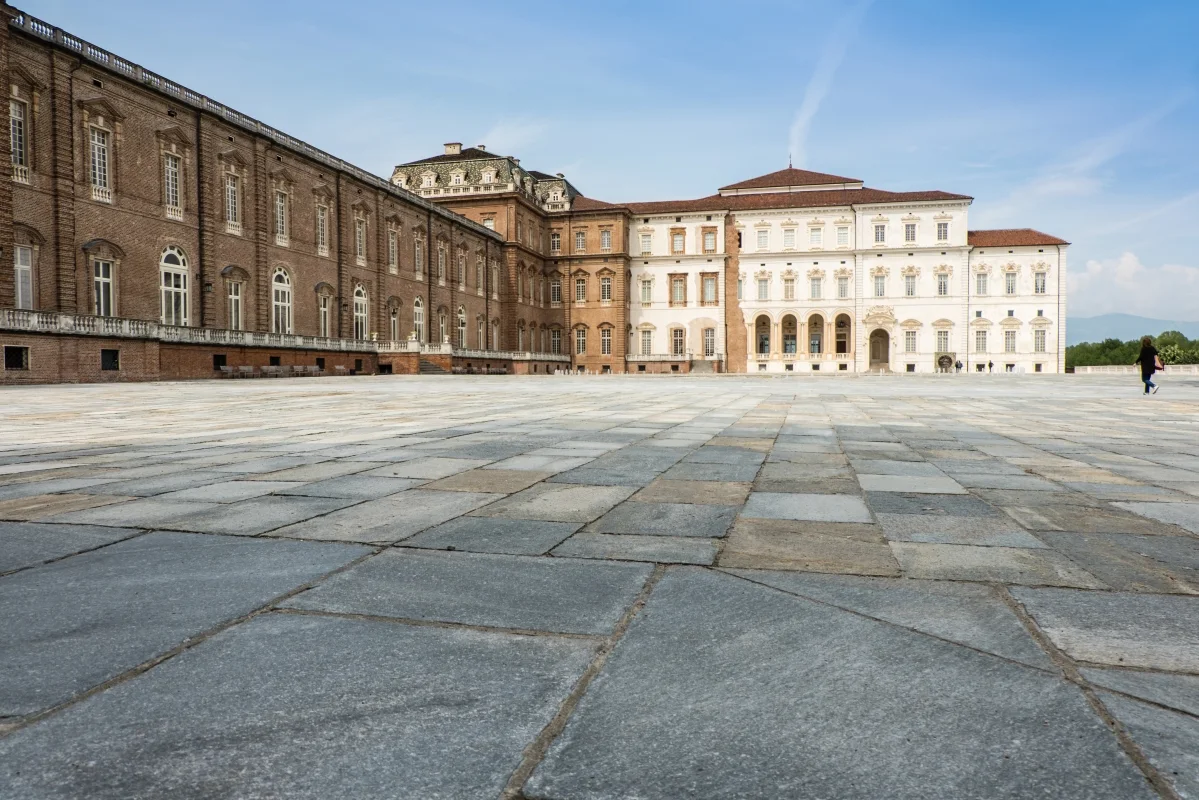
The estate changed considerably in the early 18th century. After damage caused during the War of the League of Augsburg, Michelangelo Garove prepared a more ambitious scheme. Filippo Juvarra later shaped some of Venaria’s most important architectural spaces, including the Great Gallery, the Church of Saint Hubert and the Juvarra Stables. As tastes changed, parts of the original garden were demolished or altered to create wider views and a more open relationship between palace and landscape.
The gardens eventually declined and many of their original elements disappeared. Their modern revival forms part of the wider restoration of Venaria Reale, a project that began in 1998 and led to the reopening of the complex in 2007. The result is not a literal reconstruction of every historic detail. It is a layered landscape, where surviving traces, archaeological remains, restored elements and new works of art sit alongside one another.
Start with the central axis
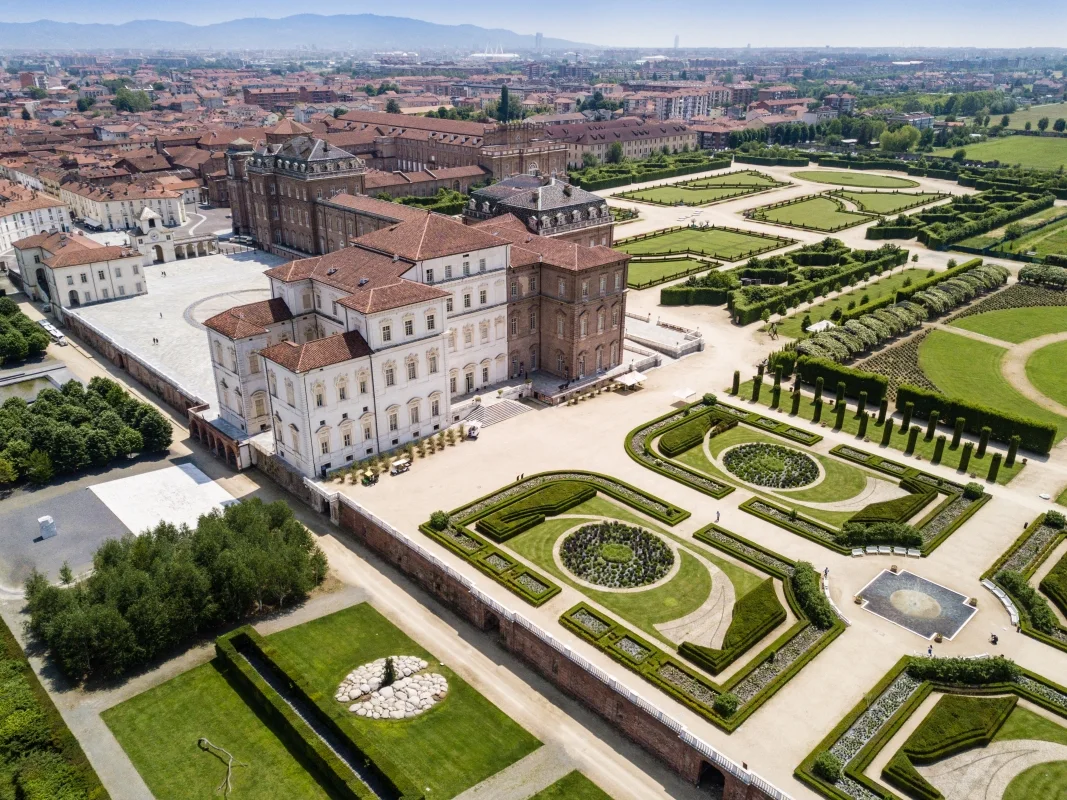
The most useful way to understand the gardens is to follow their central line. It begins in the old town of Venaria, passes through the palace and Flower Garden, then continues towards the Lower Park along the Alley of Hercules. The route makes the original planning logic visible: the village, residence and landscape were designed as parts of one continuous composition.
The Flower Garden sits close to the palace and is one of the more immediately legible spaces. Its beds follow geometric patterns, with a circular motif at the centre and planting cycles that change through the year. The selection of flowers refers both to varieties traditionally cultivated in Piedmont and to the decorative language found inside the palace.
From here, the view opens towards the longer promenade. The scale is important. Venaria was designed to be experienced through procession, with the visitor moving from enclosed architectural rooms into increasingly expansive outdoor spaces. Even when the gardens are busy, the central axis gives the visit a clear rhythm.
The Fountain of Hercules is the garden’s great set piece
The Fountain of Hercules was built between 1669 and 1672 as a theatrical transition between the upper and lower levels of the gardens. Its original design included staircases, pavilions, grottoes, marble sculpture and elaborate water effects, centred on a monumental figure of Hercules.
The fountain was demolished in the 18th century, when the garden was being reshaped around broader vistas. Parts of its marble decoration were moved to other Savoy residences, while the original structure gradually disappeared from view. Archaeological work and restoration have since brought the site back into the experience of the gardens. The restored Fountain of Hercules was completed in 2022.
Today, the fountain is one of the places where Venaria’s history becomes easiest to read. It shows how the Savoy court used water, mythology and architecture to construct spectacle. A water theatre operates here during opening days, with a show at the stroke of each hour. It is worth timing your route around it, although the setting itself is more interesting than the performance if you prefer a quieter visit.
The Lower Park brings together history and contemporary art
The Lower Park is where the gardens become less formal and more spacious. It contains the Great Pond, the remains of the Temple of Diana, traces of the 17th-century garden structures, the Potager Royal and Giuseppe Penone’s Garden of Fluid Sculptures.
The Great Pond gives the palace a long reflective foreground. In the warmer months, water lilies and planted areas add colour around the edges, but the strongest quality is the sense of distance. From here, Venaria feels less like a decorated royal residence and more like a landscape estate.
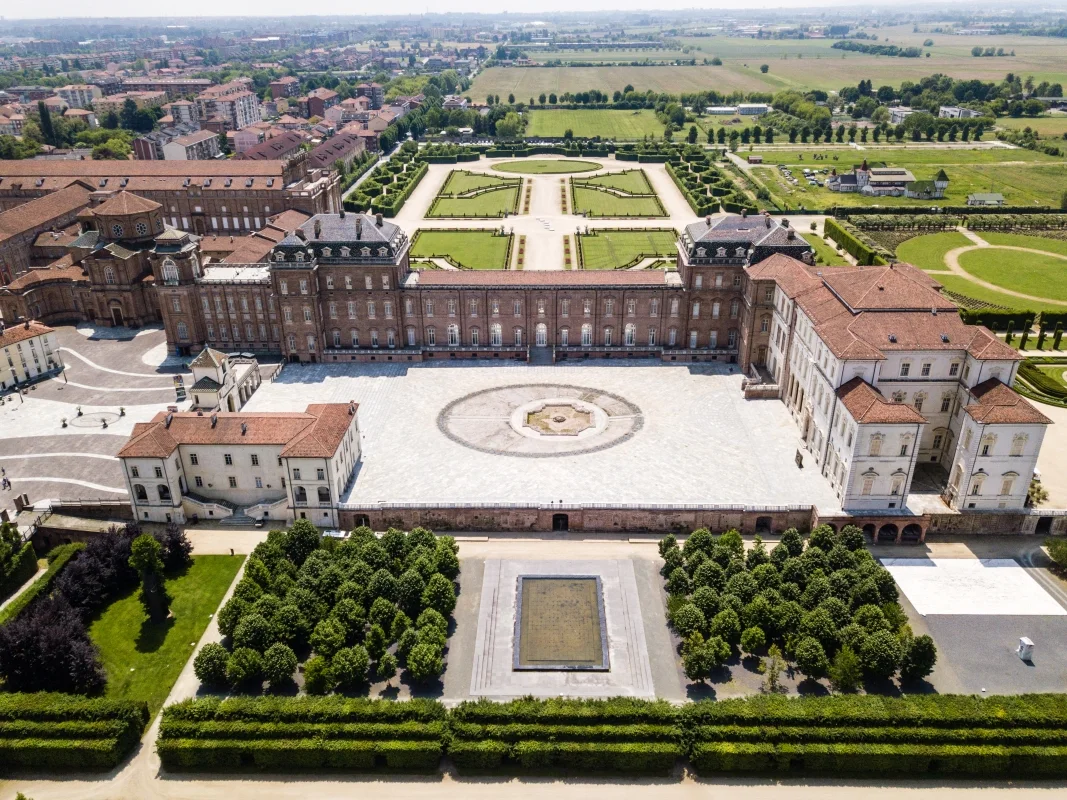
The Temple of Diana once marked the far end of the 17th-century promenade. It was demolished around 1700, and its foundations were later uncovered through archaeological excavation. The present arrangement makes the remains visible without pretending that the lost structure has survived intact. This restraint is one of the strengths of the gardens: absence is allowed to remain part of the story.
The Garden of Fluid Sculptures by Giuseppe Penone offers a deliberate change of register. Fourteen works in bronze, stone, granite, marble and water occupy roughly three hectares, drawing attention to the relationship between vegetal, mineral and human forms. The sculptures are integrated into the landscape rather than presented as objects in a conventional gallery. Allow time to walk through the area instead of viewing it from the main route.
The Potager Royal is worth the extra walk
The Potager Royal covers ten hectares of orchards and vegetable gardens and is described by Venaria as the largest potager in Italy. It belongs to a different tradition from the formal parterres: practical, productive and closely connected to the daily life of a court estate.
This is one of the most rewarding areas for visitors who enjoy gardens as living places rather than only as historic compositions. Rows of fruit trees, vegetables and planted borders create a more seasonal atmosphere, and the scale makes it feel removed from the palace even though it remains part of the same estate.
Do not expect a compact ornamental garden. The Potager is spread out, and the experience depends on walking through it. It deserves a detour when the weather is comfortable and when you have at least half a day for Venaria. If you are visiting only for the headline views, it can be left for another time.
How the gardens compare with the palace
The palace is the stronger choice for interiors, court ceremony and the work of Juvarra. The gardens are the better choice for space, landscape and a more relaxed visit. Seeing both gives the clearest picture of Venaria, but they do not need to be treated as one undifferentiated attraction.
For a first visit, we would combine the Piano Nobile of the palace with the gardens if time allows. If you have already seen several Savoy residences or prefer being outdoors, the gardens alone make a worthwhile excursion. A garden ticket is available separately, while broader tickets include the gardens with the palace and other parts of the estate.
The gardens are also a better fit for visitors who want a break from Turin’s museums without giving up culture. They provide enough history and architecture to feel substantial, but the day is shaped by walking, light and changing views rather than by a sequence of rooms.
Practical information for visiting
La Venaria Reale is at Piazza della Repubblica 4 in Venaria Reale, around ten kilometres from Turin. As of October 2026, the gardens are open from Tuesday to Sunday. From 1 October, the published hours are 9.30am to 5pm from Tuesday to Friday and 9.30am to 6.30pm on Saturdays, Sundays and public holidays. Mondays are generally closed, except on certain public holidays. Opening times and seasonal arrangements can change, so check the official calendar before travelling.
The ticket office closes before the gardens themselves, and the official site recommends booking online, particularly for busy days and combined tickets. If you want to see the palace as well, plan the order of your visit rather than arriving late and assuming the gardens will be enough time for everything.
The SFM4, SFM6 and SFM7 railway lines connect Turin, Caselle Airport and other Piedmont destinations with Venaria Reale. The Reggia di Venaria stop is around 500 metres from the ticket office, with the approach passing through the old town along Via Andrea Mensa. The Venaria Express shuttle also connects central Turin with the Reggia and the Park of La Mandria on operating days. Check current train and bus timetables before setting out.
By car, the complex is reached from Turin’s northern ring road via the Venaria or Savonera exits. The main car parks are near Via Castellamonte and Viale Carlo Emanuele II. Access arrangements have changed during bridge and road works, so drivers should follow current signage and the official travel updates rather than relying on older map instructions.
When to go
Spring is the obvious season for flowers and fresh growth, while early autumn brings softer light and a more settled pace. Summer can be enjoyable if you arrive early or visit towards the end of the day, although the exposed formal areas offer limited shade. In winter, the gardens are quieter but less generous as a purely botanical experience.
The gardens are at their most comfortable on a clear weekday morning, when you can take the central axis before spending unhurried time in the Lower Park. Weekends and public holidays are more atmospheric in some ways, but the main routes and transport connections can be busier.
For more information visit lavenaria.it