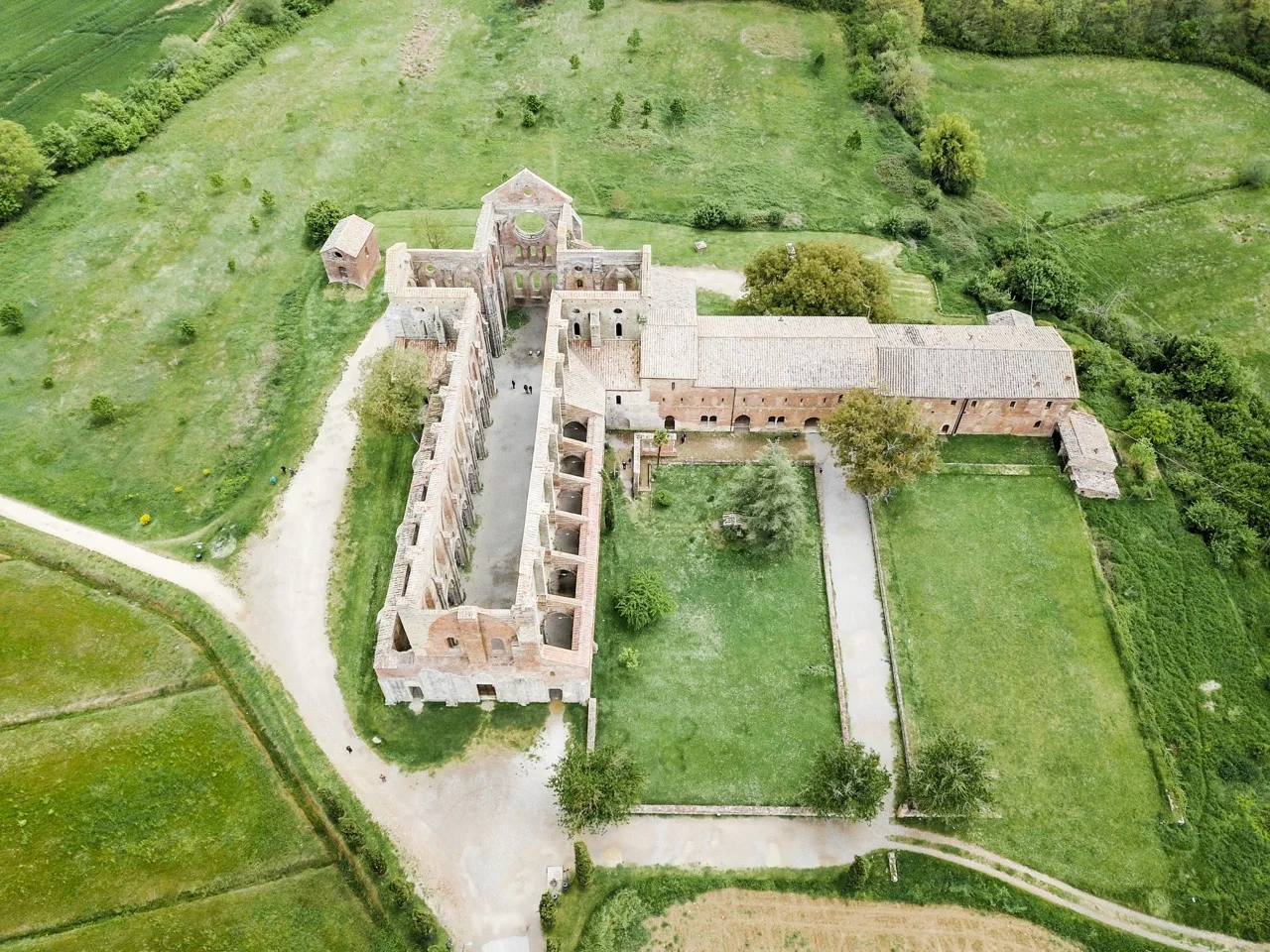
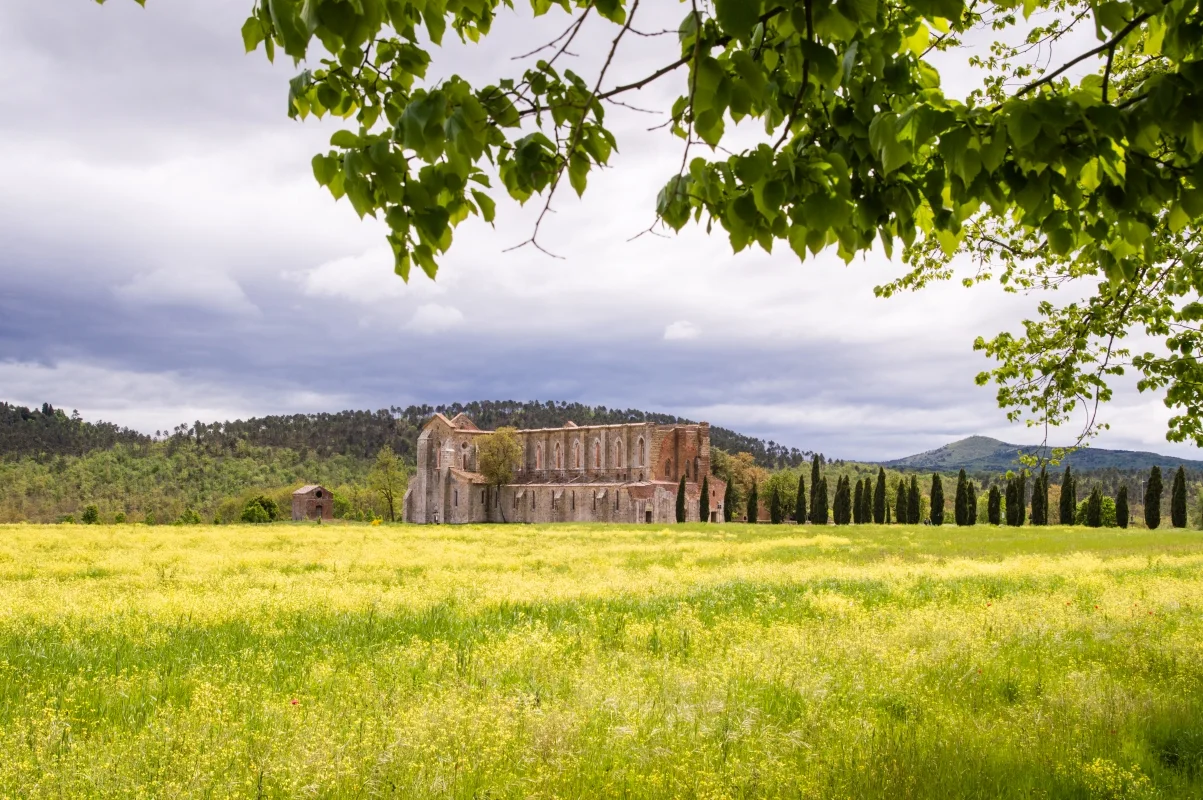
Some historic places are impressive because they remain almost exactly as they were. San Galgano has a different kind of power. Its medieval church stands without a roof, the grass has replaced the original floor and the sky occupies the space once reserved for vaults. The result is unexpectedly calm: an immense Cistercian church reduced to its essential lines, with the surrounding Tuscan landscape always present.
The abbey is in the Val di Merse, within the municipality of Chiusdino south-west of Siena. It is remote enough to feel like a proper excursion, but focused enough to visit without giving it an entire day. The nearby Hermitage of Montesiepi, with its round striped chapel and the sword associated with Saint Galgano, is part of what makes the journey worthwhile.
How long we would stay: around 90 minutes to two hours for the abbey and hermitage. Allow longer if you also visit Chiusdino or one of the local museums.
What we would prioritise: the empty nave of the abbey, followed by the Rotonda di Montesiepi. The two buildings make more sense together than separately.
Worth knowing: this is a rural site rather than a town attraction. Check current opening arrangements before travelling, particularly outside the main season.
Why San Galgano is worth the detour
Tuscany is full of beautiful churches, but San Galgano offers a more unusual experience than a conventional art-historical visit. The absence of the roof changes the scale and atmosphere of the building. Light moves across the brick and travertine walls, weather reaches the stonework and the proportions of the original Gothic-Cistercian design are unusually easy to read.
There is no elaborate interior competing for attention. The nave, arcades, transept and surviving walls do most of the work. On a quiet day, the abbey can feel more like an architectural landscape than a monument enclosed in a museum. It is a place to look up, walk slowly and notice how much structure remains after centuries of decline.
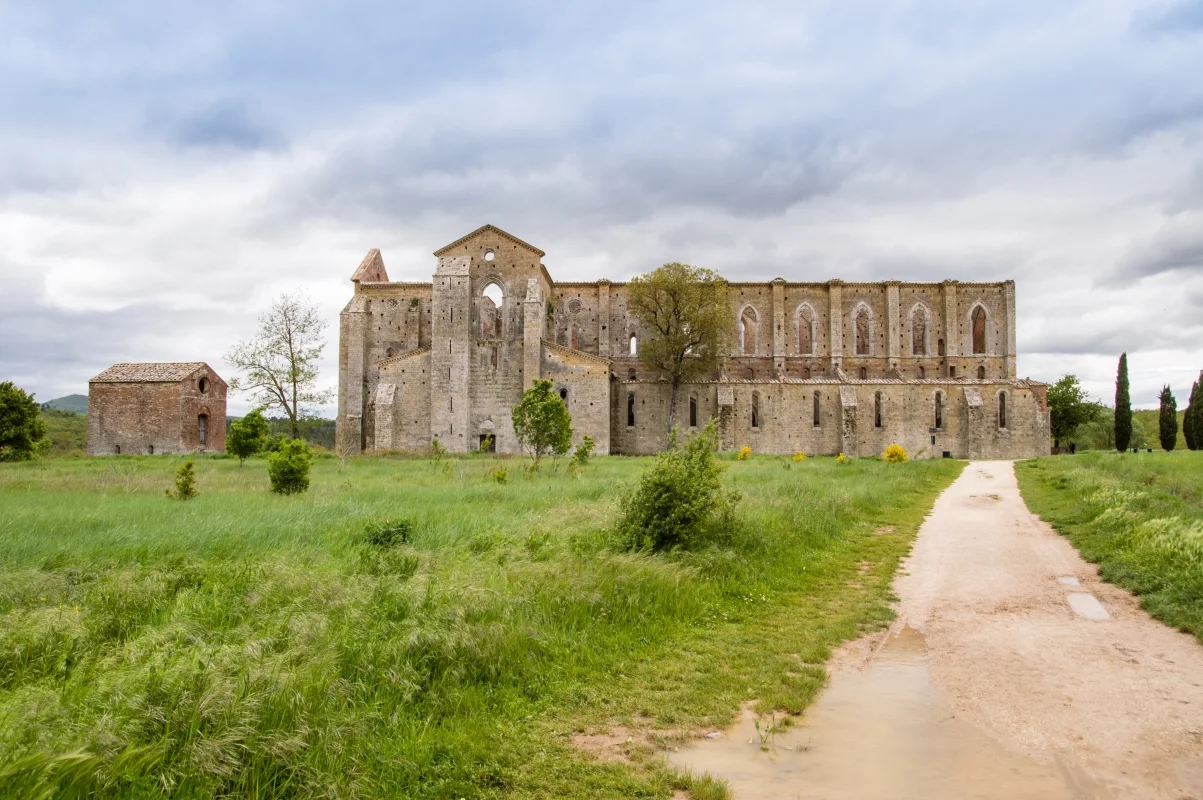
The setting matters as much as the ruins. The abbey stands in open countryside, with the wooded hills of the Val di Merse around it. It is especially appealing to travellers who enjoy atmosphere and proportion more than a long checklist of objects. If you have limited time in Tuscany, San Galgano deserves consideration when your itinerary already includes the southern Siena countryside.
A short history of the abbey
The story begins with Galgano Guidotti, a nobleman from Chiusdino who, according to the medieval accounts, abandoned his life as a soldier and retreated to the hill now known as Montesiepi. He lived there as a hermit in the final years of the twelfth century. Galgano died in 1181 and was canonised in 1185.
A small religious settlement grew around the place associated with his hermitage. Cistercian monks later established a larger monastery in the valley below, where construction of the abbey began in the early thirteenth century. The church was built between the Romanesque and Gothic periods and became one of the most important Cistercian foundations in the Sienese territory.
For several centuries, the monastery was involved in the economic and political life of nearby Siena. Its monks were connected with the administration of the republic and with major building projects, including work associated with Siena Cathedral. The abbey was therefore more than an isolated spiritual centre: it was part of the region’s wider network of power, agriculture and finance.
Its decline was gradual. The plague, political disputes, financial difficulties and the changing fortunes of the monastery weakened its position. The church was eventually deconsecrated in the late eighteenth century, and materials, fittings and parts of the roof were removed over time. What survives today is not a perfectly preserved ruin, but the architectural remains of a place that once had considerable influence.
The church beneath the sky
The main church follows the austere principles associated with Cistercian architecture. Decoration is restrained, while the emphasis falls on rhythm, light and structure. The long nave is divided by pointed arches and substantial piers, leading the eye towards the transept and the unfinished western end.
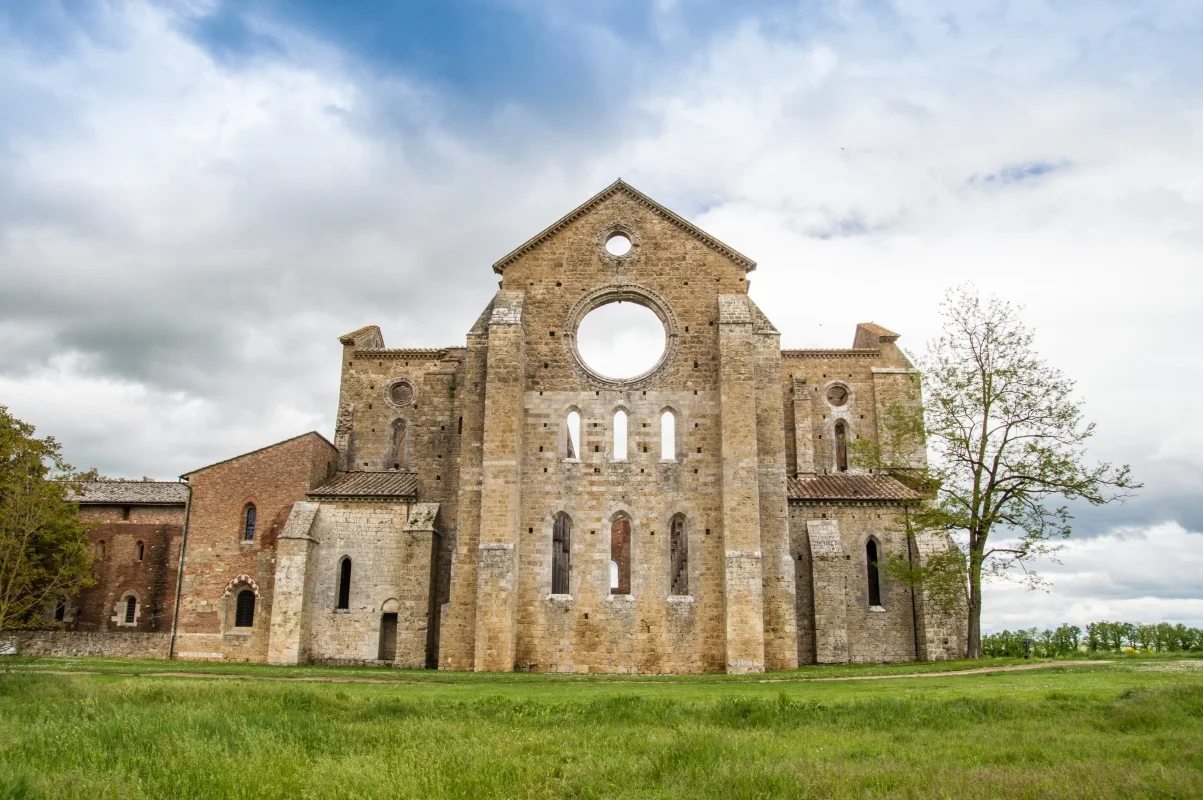
The unfinished façade is one of the details worth noticing. It gives the building a sense of incompletion that feels consistent with the rest of the site, although the abbey was once a highly organised and functioning institution. The surviving brick and stonework also reveal the changing character of medieval construction in Tuscany, where local materials were used with a quiet precision.
The missing roof is the feature most visitors remember, but it should not be the only thing you look at. Take time to follow the lines of the nave, examine the proportions of the side aisles and notice how the open upper sections frame the surrounding countryside. The building is most convincing when viewed as a whole rather than photographed only from the central aisle.
The Hermitage of Montesiepi
The smaller building on the nearby hill is the Rotonda di Montesiepi, also known as the Hermitage of San Galgano. It was built over the site associated with the saint’s retreat and has a completely different character from the abbey below.
The chapel is circular, with alternating bands of stone and brick on the exterior and a striped interior dome. Its compact scale and geometric design make it one of the most distinctive medieval buildings in the area. After the vastness of the abbey, the Rotonda feels intimate and concentrated.
At the centre is the sword traditionally associated with Saint Galgano. According to the legend, he drove his sword into the rock as a gesture of renunciation and peace. The object is protected and should be understood as part of the site’s religious tradition and storytelling rather than approached as a theatrical attraction.
The hermitage also contains a chapel connected with the fourteenth-century expansion of the building. Its decoration includes frescoes attributed to Ambrogio Lorenzetti, one of the major painters of the Sienese school. The contrast between the sword, the medieval legend and the more formal artistic history of the chapel gives Montesiepi much of its interest.
How to visit San Galgano
The complex lies at Località San Galgano, near Chiusdino in the province of Siena. It is a countryside destination, so it works best as part of a driving itinerary through the Val di Merse and the southern Sienese hills. If you are not travelling by car, confirm transport arrangements in advance rather than assuming that local connections will be convenient.
The official ticketing system allows visitors to buy admission online or at the ticket office. Depending on the ticket selected, admission can cover the abbey together with the San Galgano Civic and Diocesan Museum in Chiusdino and the Miranduolo Archaeological Museum. If you are interested in the wider history of the area, the combined option may be more useful than visiting the abbey alone.
Current published opening hours for the abbey are 9:00 to 19:00 in September and October, 9:00 to 18:00 from November through April, 9:00 to 19:00 in May and June, and 9:00 to 20:00 in July and August. These arrangements can change for events, maintenance or exceptional closures, so check the official Fondazione San Galgano information before setting out.
The site is largely open and exposed. Comfortable shoes are sensible, and a hat or water is useful in the warmer months. The abbey’s floor is uneven in places, while the hermitage is reached separately on higher ground. Visitors travelling with dogs can enter the abbey and museum provided dogs are kept on a lead.
A simple way to plan the visit
- Begin with the abbey itself, when the light is still comfortable and you can take in the full scale of the church.
- Walk through the nave and side aisles before concentrating on photographs. The proportions are easier to understand from inside the building.
- Continue to the Rotonda di Montesiepi for the circular chapel, the sword in the stone and the frescoed side chapel.
- If you have additional time, visit Chiusdino and consider one of the local museums included in the broader San Galgano cultural circuit.
- Leave space for the surrounding landscape. The rural setting is part of the experience, not merely a backdrop for the ruins.
When to go
Spring and autumn are the most comfortable seasons for combining the abbey with time outdoors. The landscape around the Val di Merse is especially appealing when temperatures are mild and the countryside is not at its driest. Summer gives longer opening hours, but the exposed nave can become hot in the middle of the day.
For a more atmospheric visit, arrive early or later in the afternoon, while remembering to leave enough time for both buildings. The open church changes noticeably with the angle of the light. Events and concerts may also take place at the abbey, so check the current programme if you are planning around a particular date.
What to combine with San Galgano
Chiusdino is the natural companion to the abbey. It is the birthplace associated with Galgano and gives more context to the local history than the isolated ruins can provide. The town museums focus on sacred art, archaeology and the history of the surrounding territory.
The wider Val di Merse is better suited to a flexible day than to a rigid sequence of attractions. Add San Galgano to a route through the countryside, a meal in a nearby village or a stay in the southern Siena area. The abbey is also a useful counterpoint to the more polished urban beauty of Siena: its appeal lies in restraint, weathered materials and open space.
Who will appreciate it most
San Galgano is particularly good for travellers interested in medieval architecture, religious history, photography and places with a strong sense of atmosphere. It suits couples, culturally curious families and anyone who would rather spend an hour in one memorable building than rush through several minor sights.
It may be less satisfying if you want a fully furnished church, a large collection of artworks or a destination that can be reached easily without planning. The abbey is not a complete medieval complex in the conventional sense. Its value comes from what remains, what has disappeared and the unusual relationship between the ruined church and the open Tuscan landscape.