Hidden below Učka, near the small village of Kožljak, an abandoned railway twists and dips through the landscape as if someone bent the tracks by hand. It is called Pijana pruga — the Drunken Railway — and it may be one of the strangest places to discover in Istria.
There are places you expect to impress you, and then there are places that sound almost too strange to be real. Pijana pruga belongs to the second category. We had seen photographs before arriving, with railway tracks rising and falling in unusual waves, but we assumed the camera angle made them look more dramatic than they really were. It didn’t. The railway genuinely looks as though the ground beneath it had melted and shifted overnight.
What makes the place even more interesting is how quietly it appears. There is no large attraction sign, no visitor centre and no polished tourist infrastructure waiting nearby. You are simply in eastern Istria, surrounded by small villages, dry stone walls, forest and the lower slopes of Učka, and somewhere among all of that is a railway that no longer behaves like a railway.
In this story
We almost drove straight past it
One of the easiest access points is around Zagrad, close to Kožljak, from where the unusual section of the railway can be reached on foot. The walk is short enough to feel easy, but long enough to make the discovery more satisfying. At first, you are simply following an old railway line. Then the geometry starts to change.
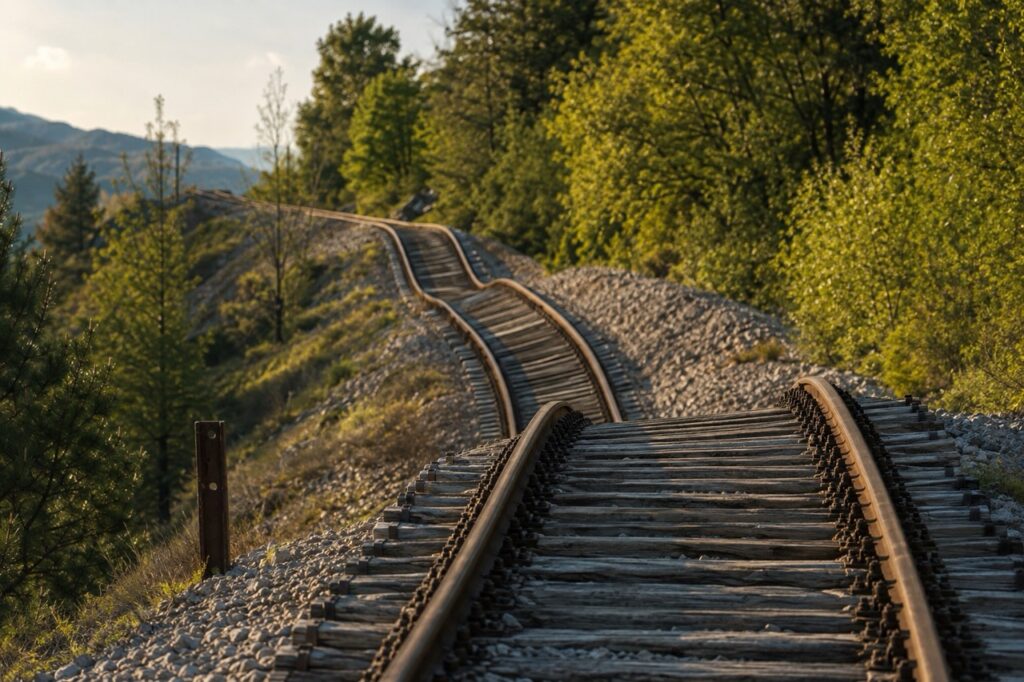
The rails begin to rise and fall in slow curves, while sections of the track lean sideways. What is normally one of the most precise forms of infrastructure suddenly looks completely unstable. That contrast is probably what makes the place so visually striking.
The closer we came, the more interesting it became. From one angle, the track looked only slightly distorted. A few steps later, the same section looked almost like a roller coaster. We kept stopping and turning around because every direction changed the shape completely.
The railway did not bend by accident
The nickname Pijana pruga makes the place sound playful, but the reason behind the distortion is far more practical. The railway is part of the old Lupoglav–Raša line, which was built in the late 1940s and opened in 1951, primarily to support the coal industry around Raša. The route crossed difficult terrain, and over time some sections became affected by unstable ground and landslides.
According to HŽ Infrastructure, the Kožljak embankment was one of the most problematic sections, with geotechnical instability eventually contributing to the suspension of traffic in 2008. The land beneath the track gradually moved, while the railway structure remained in place, creating the strange waves that can still be seen today.
Once we understood what had happened, the place became even more fascinating. What initially looks almost surreal is actually the visible result of geology slowly winning against engineering.
Nature has turned the railway into something completely different
There is something unexpectedly beautiful about seeing such a rigid piece of infrastructure lose its shape. Railways are designed around straight lines, calculated gradients and predictable geometry, but here the track flows through the landscape in long uneven waves.
Grass grows between the sleepers, vegetation has started reclaiming the edges, and the mountains create a dramatic background behind the rails. In some places, the railway feels less like abandoned infrastructure and more like accidental land art.
The most famous distorted section is relatively short, so this is not a place where you need an entire day just to walk beside the tracks. Still, we would not recommend arriving, taking one photograph and immediately leaving. The best views appear as you move along the railway and look back from different angles.
Mindful Vacation tip
Walk slightly beyond the most photographed section and then turn around. The shape of the railway becomes much more obvious when viewed from a distance, especially when the light creates shadows along the rails and sleepers.
The history here is heavier than the photographs suggest
The Lupoglav–Raša railway was built during the post-war period, and its construction was demanding. The route was closely connected with the mining industry of eastern Istria and represented an important industrial connection through difficult terrain.
Historical accounts describe the construction conditions as extremely harsh. Workers had to cut through a rugged landscape with limited equipment, and the line became part of the wider industrial story of Raša and Labin.
That history changes the atmosphere of the place. It is easy to arrive because of a photograph on social media, but when you start thinking about why the railway was built, who worked here and how important it once was, it becomes much more than an unusual photo stop.
Kožljak is worth exploring too
We would not visit Pijana pruga without spending some time around Kožljak. The village and its surroundings are quiet, rural and very different from the polished coastal image of Istria. Above the area are the remains of Kožljak Castle, whose history stretches back centuries.
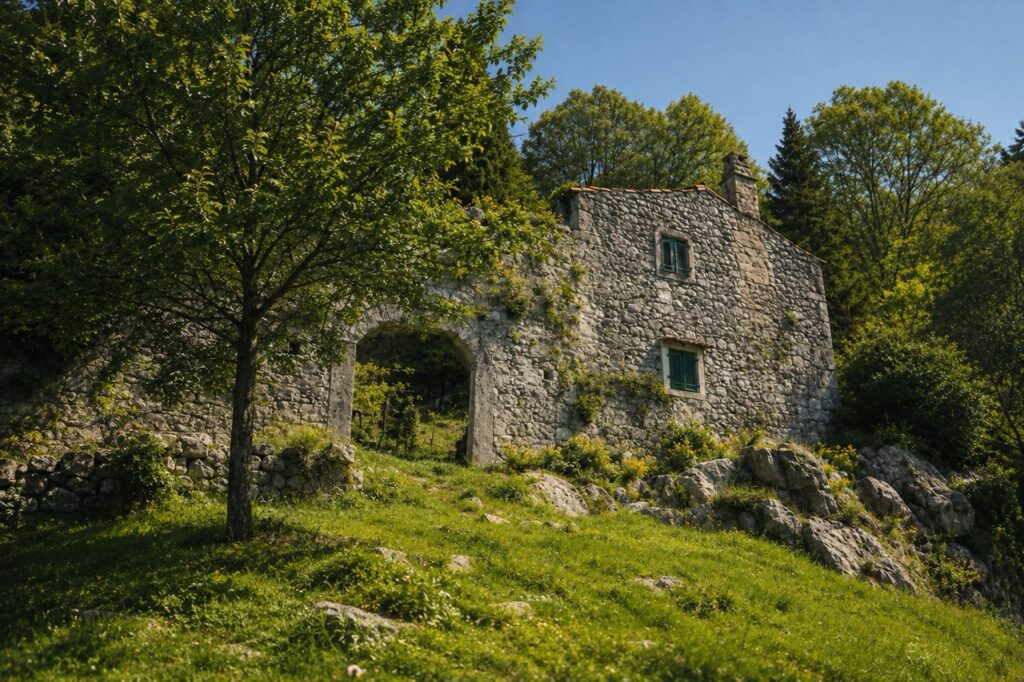
This part of eastern Istria feels rougher and more remote than places such as Rovinj, Poreč or Motovun. There are fewer tourists, fewer carefully restored facades and far less of the feeling that everything has been prepared for visitors.
That is exactly what we liked about it.
You get old roads, ruins, forest, industrial history and small villages that still feel connected to the landscape around them.
Pair it with Vela Draga
If we were planning the day again, we would combine Pijana pruga with Vela Draga in Učka Nature Park. The drive between the two is short, and together they make much more sense than visiting the railway as an isolated attraction.
Vela Draga is known for its dramatic limestone formations and unusual geological landscape. After seeing a railway distorted by unstable ground, it is interesting to continue into a place where geology itself becomes the main attraction.
The contrast works beautifully. One place shows what the landscape can do to human infrastructure, while the other shows what the landscape can create entirely on its own.
This is not postcard Istria
Most people who visit Istria naturally focus on the coast, hilltop towns, wineries and food. Rovinj, Motovun, Grožnjan and Cape Kamenjak deserve their popularity, but they only represent one side of the peninsula.
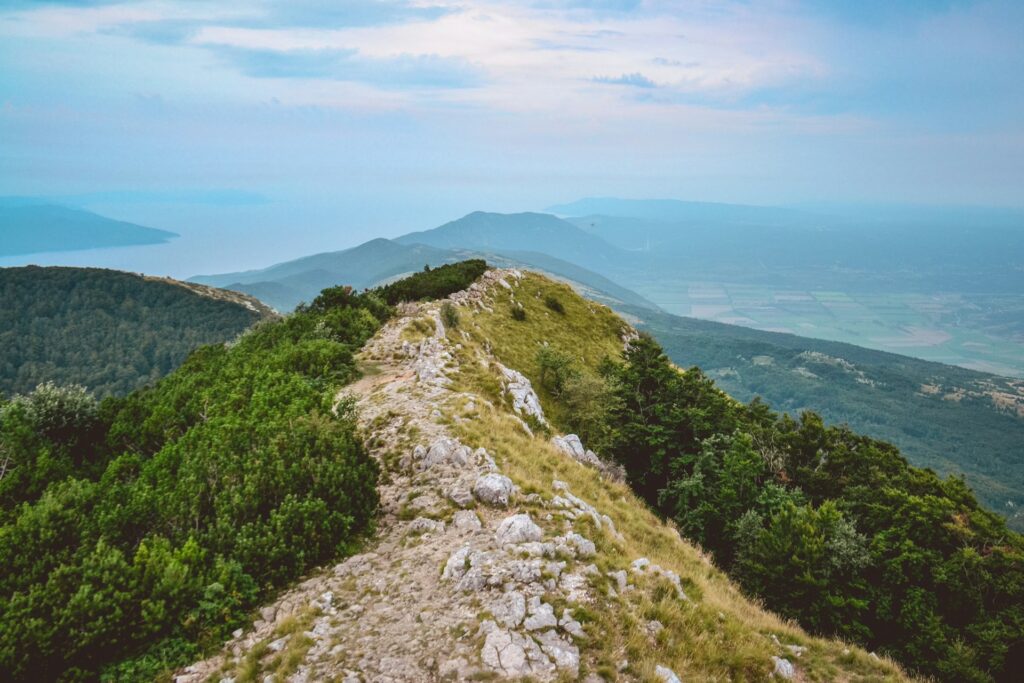
Eastern Istria has a different personality. It feels quieter, more mountainous and less curated. There are traces of mining, industry and abandoned infrastructure, but there are also villages, forests and landscapes that feel almost completely untouched by mass tourism.
Pijana pruga fits perfectly into that version of Istria. Nobody designed it to become an attraction, and that is probably why it feels so memorable.
Is it safe to visit?
This is still an abandoned and damaged railway, so it should not be treated like a managed walking trail. The ground can be uneven, the sleepers may be slippery, and vegetation can hide holes or unstable sections.
We would avoid visiting immediately after heavy rain, when the terrain can be muddy and more difficult to navigate. Good shoes are a much better idea than sandals, and there is no reason to climb beneath unstable sections or take unnecessary risks just to get a photograph.
The railway is visually dramatic enough from the ground.
Could the railway ever return?
Interestingly, the story of the line may not be completely finished. HŽ Infrastructure has studied the possibility of revitalising the Lupoglav–Raša railway, including geotechnical studies and plans related to reconstruction.
That gives Pijana pruga an unusual temporary quality. It feels abandoned, but perhaps not permanently. If the line is ever restored, the distorted railway we see today could disappear.
That is another reason the place feels worth documenting now.
When we would visit
For us, the best time would be spring or early autumn. Summer can be hot, especially on exposed sections, while spring brings greener surroundings and autumn gives the landscape warmer, softer colours.
We would also choose either morning or late afternoon if possible. Lower light creates better shadows and makes the movement of the railway much easier to see.
There is no need to rush. This is a place that works best when you allow yourself enough time to walk, turn around, explore and notice how the landscape changes around the track.
How we would plan the perfect half-day
We would start near Zagrad, walk to the railway and explore the most distorted section slowly. After that, we would continue toward Kožljak, spend some time around the village and then drive toward Vela Draga.
That is enough for a very good half-day without trying to squeeze too much into the itinerary. We would not combine it with Rovinj or Pula on the same day. This side of Istria deserves its own pace.
And that may be the most important thing about Pijana pruga. It is not one of Croatia’s major attractions, and it does not need to be.
It is simply one of those places that makes you stop and look twice.
You know exactly what railway tracks are supposed to look like, but here they are doing something completely different. That small moment of confusion is what makes the visit memorable.
Mindful Vacation tip
Do not think of Pijana pruga as a destination worth crossing Croatia for on its own. Think of it as a wonderfully strange detour through eastern Istria.
Pair it with Učka, Vela Draga and the villages around Kožljak, and you get a day that feels very different from the Istria most travelers know.